
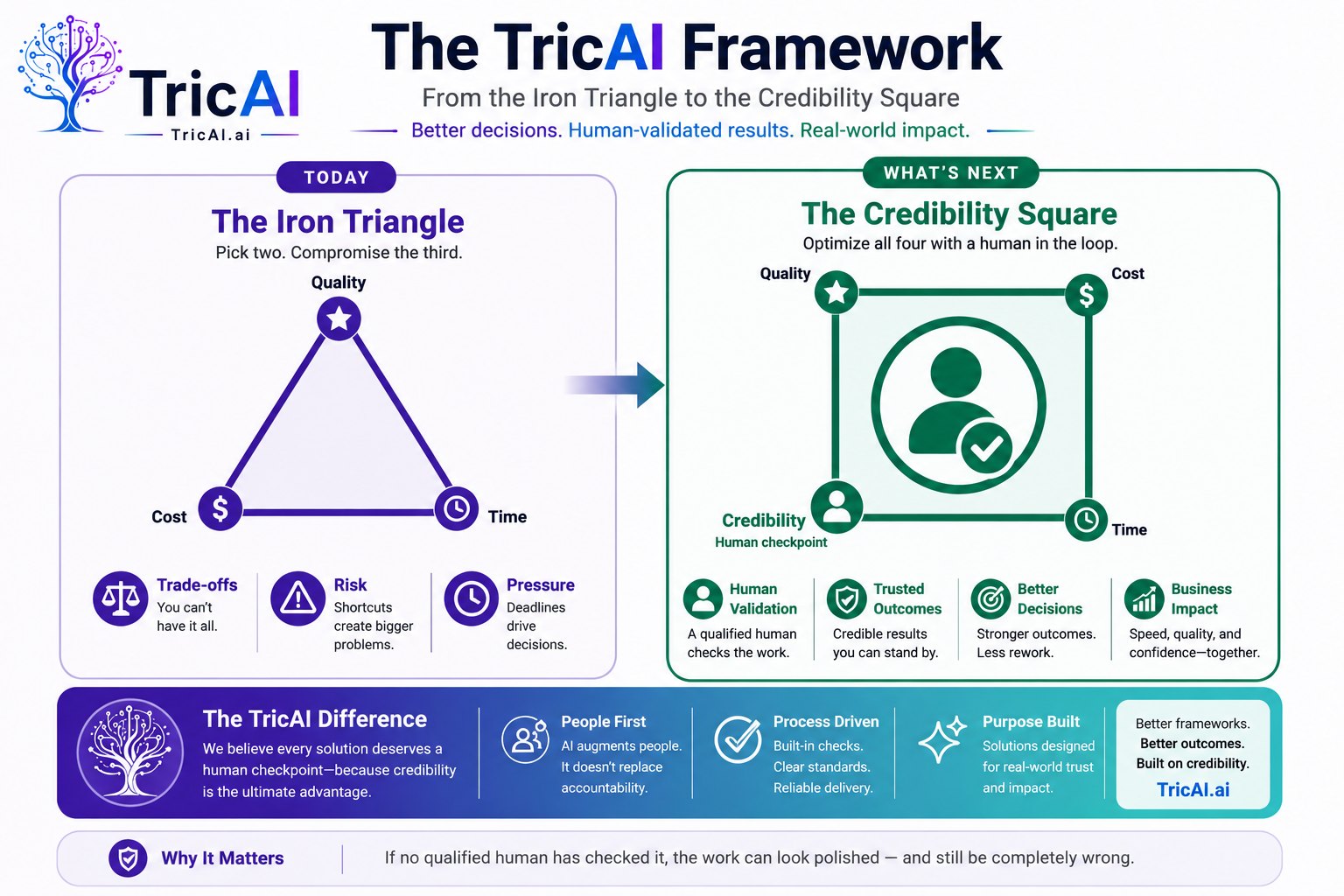
For decades we were taught the same iron triangle: quality, cost, time. Pick two.
You could move fast and cheap, but quality suffered. You could get quality fast, but it cost you. The constraint felt like a law of nature.
Having worked with resource-strapped startups, I've watched AI deliver quality work, fast and cheap. All three corners at once. The trade-off that defined operations for a generation simply stopped holding.
But collapsing the triangle exposed a fourth corner we never had to measure before: credibility.
If no qualified human has checked what the AI produced, the work can look polished and still be completely wrong. Fast, cheap, high-quality, and untrustworthy. So we're moving from a triangle to a square, where "a qualified human reviewed this" becomes something we actually measure.
The same judgment that catches a phishing email is the judgment that vouches for the work. The task over the next two years isn't to automate that judgment away. It's to protect and certify it.
Keeping human oversight while you automate fast
The goal isn't a human on everything. That doesn't scale, and it's exactly what turns review into rubber-stamping. Make credibility a measured gate at the points that matter:
- Risk-tier the work. Reversible, low-stakes output can ship on AI alone. Anything irreversible or customer-, regulator- or dollar-facing requires a named, qualified reviewer before it leaves the building.
- Make "a qualified human reviewed this" a real artifact. Log who checked it, what they verified, and when. The fourth corner becomes an auditable metric instead of a vibe.
- Certify the reviewers, not just the review. Define what "qualified" means per domain, and protect that capacity rather than cutting it as you automate.
- Sample the rest. Spot-check a percentage of the auto-shipped tier to catch drift without bottlenecking everything that's low-risk.
The shift is from "review everything" to "certify judgment where it's load-bearing."
That's the corner the square adds, and the work of the next two years. The framework is in active development as a practical operating model. Let's talk about putting it to work with your team →